

Bethesda Roof Repair & Replacement Guidance
Another repair.
Or finally fix it right
Not every roof problem means you need a new roof. But not every roof problem should be patched either. The right answer depends on what the system is actually doing — not on a number someone gives you before they’ve looked.
We’ll tell you repair, monitor, or replace — whichever is actually true for your roof.
Google Reviews
5.0 – 38 Reviews
Workmanship
20-Year Warranty
Maryland License
MHIC 147572
Rafael on Every job
VA Class “A”
2705183873
THE REAL QUESTION
A repair is not always cheaper.
A replacement is not always necessary.
Most homeowners in Bethesda and Montgomery County are handed one of two answers: patch it or replace it. Neither is right until someone has actually looked at what’s failing — and why.
A 12-year-old Bethesda roof with a cracked pipe boot and one leak trace needs a $600 repair. A 16-year-old roof with three active leak paths, failed valley flashing, and widespread granule loss is probably closer to replacement than its age suggests. Age is one signal. The condition of the full system is the actual answer.
“We’ve seen homeowners spend $5,000 in repairs over four years on a roof that needed replacement from the start. By the time they called us, they’d paid for a third of a new roof — and still needed one.”
— Rafael Huguet, Owner, Rebel Roofer
What Most Homeowners Actually Need
We don’t tell you what to do until we understand what’s happening. When we do, it almost always falls into one of three situations.
- Roof Repair
The issue is contained. The surrounding system is still performing. A targeted repair solves the problem without overbuilding.
2. Monitor & Plan – Maintenance
No active emergency, but warning signs are building. Watch it closely and plan the replacement before it becomes urgent.
3. Roof Replacement
The system is failing in more than one place. More repairs mean more money spent delaying the inevitable.

Should you Repair or Replace Your Roof in Bethesda?
Some roofs still deserve a proper repair. Others have reached the point where additional patchwork only delays a larger and more expensive issue. We help you make that distinction clearly.
WHEN REPAIR IS THE RIGHT CALL
Some Bethesda roofs still deserve a proper repair.
Not a patch — a repair.
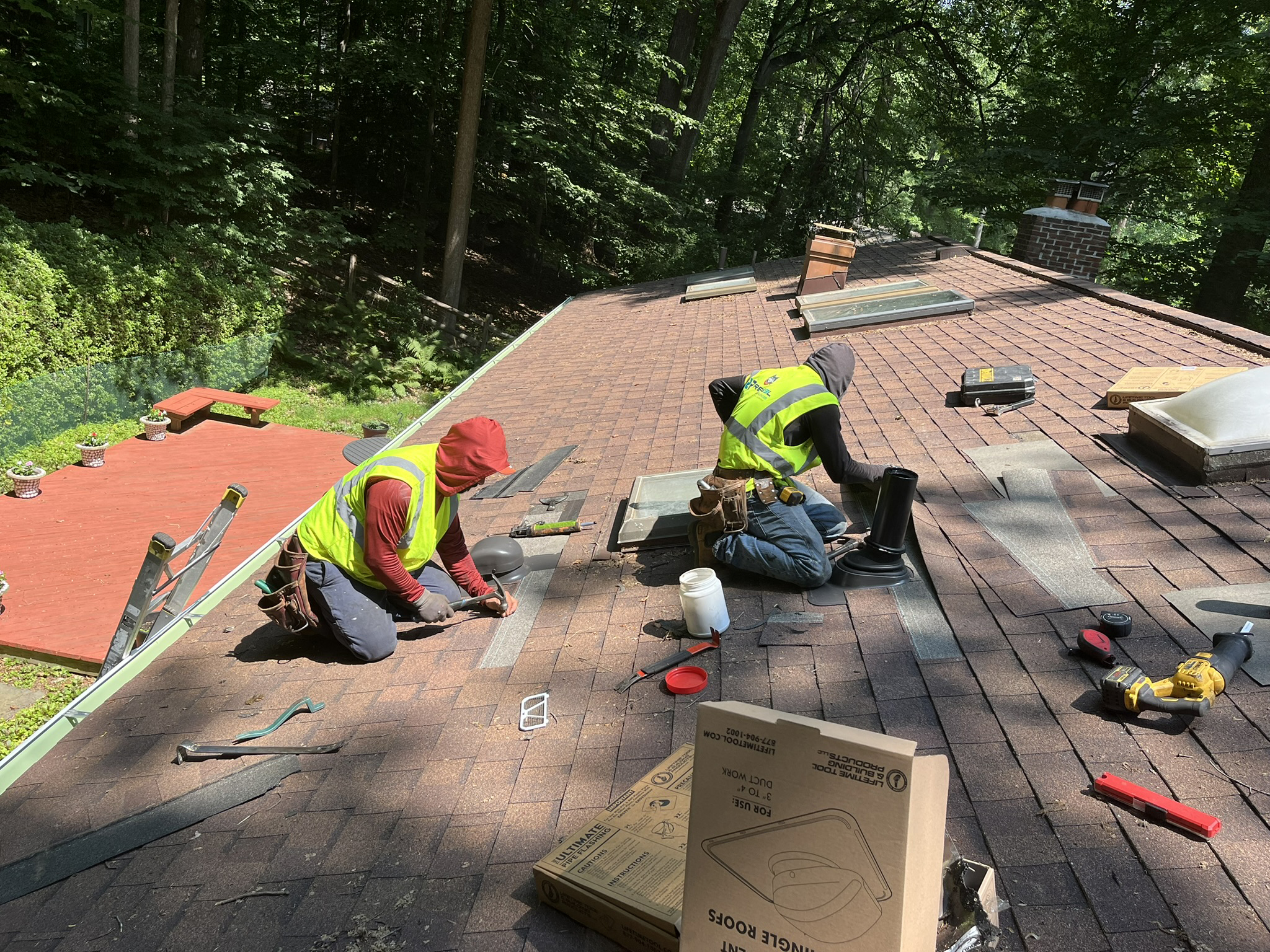
Not every roofing issue calls for replacement. When the roof still has useful life and the problem is confined to a specific area or component, a targeted repair resolves it without unnecessary work or disruption.
The difference between a repair that holds and one that fails again isn’t the shingles. It’s whether the root cause was addressed — or whether someone sealed over the symptom and left.
REPAIR IS OFTEN WORTH CONSIDERING WHEN:
- ✅ The issue is isolated — one flashing, one pipe boot, one area
- ✅ The surrounding roof system is still in serviceable condition
- ✅ The problem is centered on a flashing or penetration detail
- ✅ The roof is not showing broad brittleness, curling, or system-wide decline
If you’re serious about protecting your home and making the right long-term decision, we’re here to guide you. For homeowners focused primarily on the lowest price or short-term fixes, our approach may not be the best fit — and that’s perfectly okay.
REPAIR IS OFTEN THE BETTER PATH WHEN:
- ✅Problems are appearing in multiple areas
- ✅Repairs have become repetitive
- ✅Shingles are losing seal, flexibility, or granules broadly
- ✅Ventilation or system design issues are shortening roof life
- ✅The roof is aging to the point where repairs no longer solve the real problem
- ✅You want peace of mind — and to stop thinking about your roof

WHEN ROOF REPLACEMENT IS THE RIGHT CALL
Sometimes replacement is not more extreme — it’s more practical
When the roof is showing broader system failure, another repair can become a short-term patch on a long-term problem. In those cases, replacement is often the clearer and more predictable path forward.
COMMON WARNING SIGNS
Signs Your Roof May Need More Than a Simple Repair
The surface doesn’t always tell the full story. Many roofs that look acceptable from the ground are already showing deeper weakness once the details are evaluated carefully.
Repeated Repairs
When the same roof keeps needing attention, the issue is often bigger than the last symptom.
Multiple Trouble Areas
If failures are appearing across several sections, the system may be aging beyond practical repair.
Ventilation-Related Aging
Poor airflow can shorten roof life quietly from the inside out, even before leaks appear.
Detail Failure at Critical Areas
Flashing, penetrations, valleys, and transitions often reveal when a roof is breaking down system-wide.
| What you see | What it usually means | Urgency |
|---|---|---|
| Water stain on ceiling | Water doesn't leak where it enters — it travels. The stain is almost never where the roof is failing. The source is usually a flashing, pipe boot, or valley issue well above where it appears. | Act now |
| Repaired it before. Leaked again. | The repair addressed the symptom, not the cause. This is the clearest signal that continued patching is the wrong approach. The next dollar spent on another surface fix is likely wasted. | Act now |
| Curling or lifting shingles | Poor ventilation, aged material, or deck moisture — often all three at once. Shingles don't curl on their own. Something underneath is driving it. | Evaluate soon |
| Granules in gutters after rain | Some granule loss is normal on any roof. Heavy, consistent loss after rain signals the shingle surface is breaking down broadly. Isolated granule loss is maintenance. Widespread loss is a system signal. | Evaluate soon |
| Repeated repairs in the same area | The underlying cause was never addressed — only the visible result. Each repair that fails faster than the last confirms the root issue is still there. | Act now |
| Ice dams forming in winter | Heat escaping through the attic melts snow at the ridge, which refreezes at the eaves and backs up under shingles. This is a ventilation failure — not a shingle problem. New shingles won't fix it. | Evaluate soon |
| Soft spots when walking the roof | Deck deterioration from long-term moisture intrusion. By the time you feel it, it has been building for months. Soft decking almost always means the damage extends beyond what's visible. | Act now |
| Multiple trouble areas at once | One problem is a detail failure. Several at once is systemic decline. The system is aging beyond practical repair. | Act now |
| No symptoms — roof is 12+ years old | Pipe boots and flashing sealants are approaching end of useful life even when nothing has leaked yet. A proactive evaluation now costs far less than an emergency later. | Plan ahead |
| A good evaluation tells you which category you're in — repair, monitor, or replace — without pressure toward any of them. | ||
Surface symptoms are easy to misread. The right call comes from understanding what's happening at the system level — not just what's visible from the ground.
A SMARTER WAY TO THINK ABOUT COST
The cheapest next step is not always
the least expensive decision.
A repair may cost less today — but if the roof is already in broader decline, repeated fixes can add up without delivering real peace of mind. Our goal is not to sell a bigger project — it’s to recommend the option that makes the most sense for the condition of your roof, whether that’s a repair, a replacement, or simply monitoring. We’re not here to give you the lowest number upfront — we’re here to help you avoid the most expensive outcome over time.
WHY HOMEOWNERS GET MIXED ANSWERS
A rushed estimate often misses the real decision
Homeowners are often given conflicting answers because the roof was not evaluated deeply enough. Looking quickly at the surface is not the same as understanding how the system is performing.
SURFACE-ONLY INSPECTIONS
What looks fine from below may already be compromised in transitions, ventilation, or drainage details.
SYMPTOM-BASED RECOMMENDATIONS
Fixing the visible symptom without understanding the cause leads to repeat problems and repeat bills.
PRESSURE BEFORE CLARITY
The right decision should come after understanding the roof — not before the estimate is written.
THE REBEL ROOFER 6 INTEGRITY SYSTEM
We do not approach roofing as a simple shingle swap. A dependable roof depends on how six connected systems perform together.
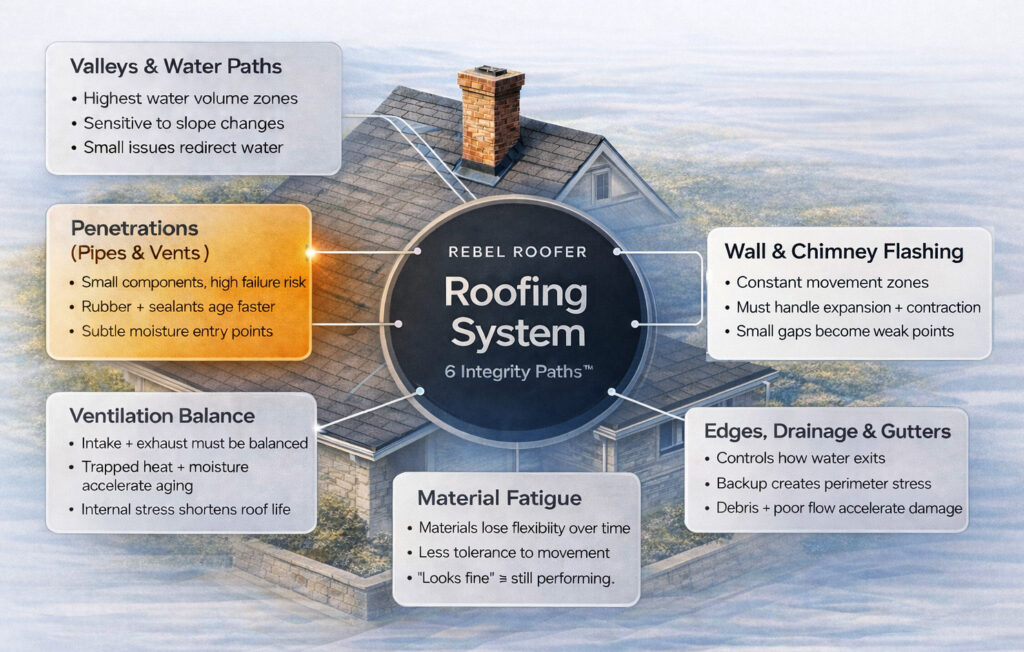
- Material Integrity
The roofing material must handle weather, movement, and aging without becoming brittle too early.
2. Penetration Integrity
Pipe boots, vents, and penetrations are common weak points when poor components or shortcuts are used.
3. Water Path Integrity
Valleys and drainage areas must move water off the roof correctly without trapping moisture or debris.
4. Ventilation Integrity
Balanced intake and exhaust help reduce heat and moisture buildup that quietly shortens roof life.
5. Perimeter Water Integrity
Roof edges, gutters, fascia, and runoff control all affect how long the roof system truly performs.
6. Flashing Integrity


Frequently Asked Questions
Clear answers to the questions homeowners actually ask — about the decision between repair, monitoring, and replacement — before you talk to anyone
When repairs are happening more than once in the same area, when problems are appearing in multiple sections at the same time, or when the roof is 18+ years old and showing compound weakness — you’re likely past the point where repairs deliver real value. The clearest signal is when each repair fails faster than the last. That’s not a flashing problem anymore. That’s a system problem.
A repair holds when the root cause is addressed — not just the visible symptom. If we can identify the source clearly, define a contained scope, and confirm the surrounding system is still sound, it will hold. If we can’t confirm those things, we’ll tell you before we start — and explain what the more practical path looks like.
It almost always means the repair addressed the symptom, not the source. This is one of the most common situations we walk into — and one of the clearest signs that a deeper evaluation is overdue. Spending more on another surface fix at this point is usually the wrong move. The next step is understanding what’s actually causing it.
A patch covers the visible symptom — it seals over what you can see without addressing what caused it. A proper repair identifies the source, corrects the underlying issue, and uses compatible materials detailed correctly so it holds. Patches fail. Repairs — done right — don’t. Our minimum charge is $450 because anything less doesn’t allow for the access, inspection, and detailing a real repair requires.
Most of the deterioration we find during evaluations is well underway before any interior leak appears. Pipe boots crack, flashing separates, valleys collect debris — none of it visible from the ground, none of it showing up inside until it’s been building for months. If your roof is 10+ years old, an evaluation gives you a clear picture of where it stands before you’re dealing with an emergency.
Rafael walks the roof and inspects the attic personally — not a salesperson, not a subcontractor. He documents condition with photos, assesses all six integrity systems, and gives you a clear written summary of what’s happening and what — if anything — needs to be done. You get a straight answer, including if that answer is that your roof is fine and nothing needs attention right now.
The rating on the package says 25–30 years. The roofs we’re replacing in Bethesda and Montgomery County tell a different story. We constantly replace roofs that are 7, 10, 12 years old — not because the shingles failed on their own, but because the system underneath them was never right. Poor ventilation, minimum-standard pipe boots, shortcuts at the flashings. Maryland’s freeze-thaw cycles and summer humidity accelerate every one of those weaknesses. A roof’s lifespan is determined by the quality of the full installation — not the number printed on the shingle bag.
A roof replacement typically recoups 60–70% of its cost in resale value, but the more relevant benefit for most homeowners is that a failing roof actively reduces value and complicates sales. Buyers and inspectors flag roof condition immediately. A well-documented replacement with a quality material and a transferable warranty removes that risk entirely — and gives buyers confidence in the whole house.
Then that’s what you’ll hear. Our goal is to give you an accurate picture of your roof’s condition — not to generate a project. If the roof is performing well and nothing needs immediate attention, we’ll tell you what to watch and when to revisit. We’re not the right fit for every homeowner — and that’s intentional.
IF YOU’RE REPLACING – YOUR NEXT DECISION
Not all shingles perform the same
in Maryland’s climate.
If the evaluation points toward replacement, the material choice is the next question most homeowners aren’t prepared for. SBS modified shingles handle Maryland’s freeze-thaw cycles and summer heat differently — and the gap in real-world performance is worth understanding before you sign anything.
Get a Clear Answer About Whether Your Roof Should be Repaired or Replaced
If your roof is stable, we’ll tell you. If a repair makes sense, we’ll explain the scope and limitations.
If planning ahead is the smarter move, you’ll understand why. This is not a rushed estimate. It is a professional roof and attic evaluation designed to help you understand whether the right next step is repair, replacement, or simply a plan.
We’re not the right fit for every homeowner — and that’s intentional. We’re a strong fit for those who value clarity, long-term performance, and getting the job done right the first time.